Research
Published Journal Articles
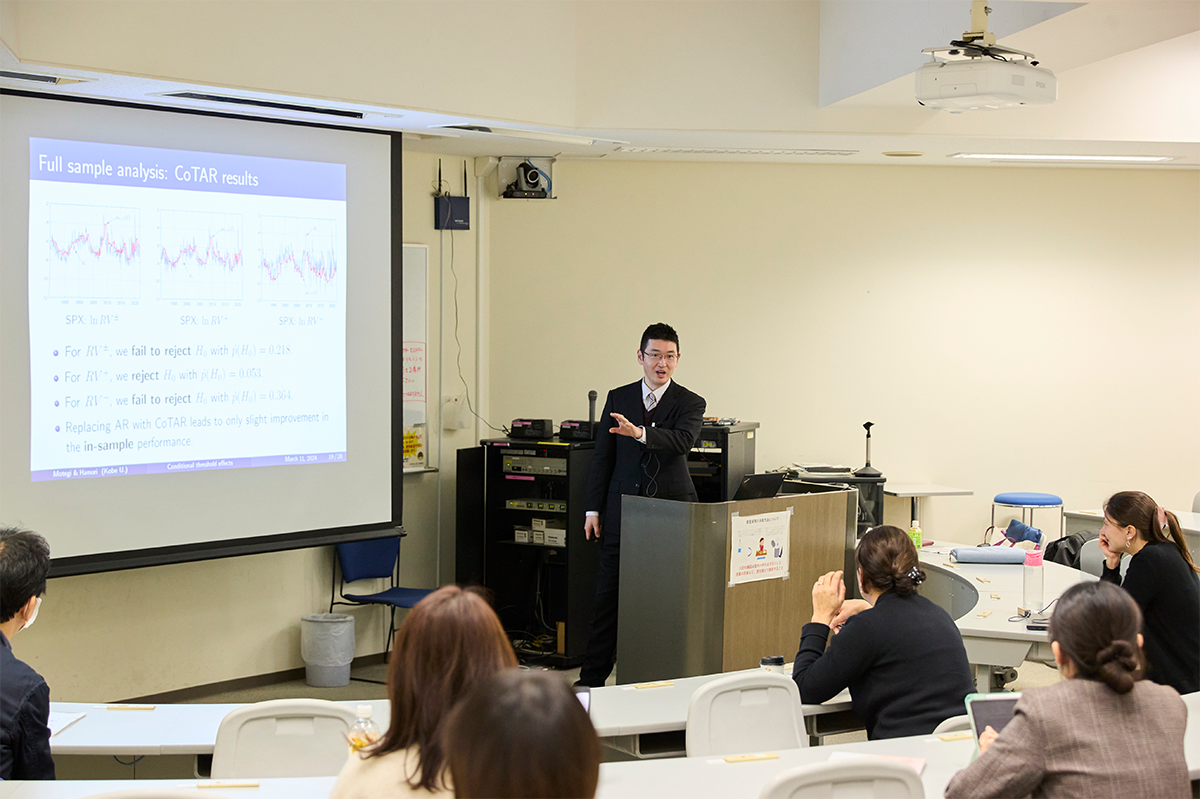
I organized the International Conference on Time Series Econometrics (ICTSE) at Kobe University in March 2024.
Testing for Granger causality with mixed frequency data (with E. Ghysels and J. B. Hill), Journal of Econometrics, vol. 192, May 2016, pp. 207-230. Main paper Technical appendix Matlab codes
Sluggish private investment in Japan’s Lost Decade: Mixed frequency vector autoregression approach (with A. Sadahiro), North American Journal of Economics and Finance, vol. 43, January 2018, pp. 118-128. Main paper Matlab codes
Testing the white noise hypothesis of stock returns (with J. B. Hill), Economic Modelling, vol. 76, January 2019, pp. 231-242. Main paper Supplemental material Matlab codes
Calibration estimation of semiparametric copula models with data missing at random (with S. Hamori and Z. Zhang), Journal of Multivariate Analysis, vol. 173, September 2019, pp. 85-109. Main paper Supplemental material Matlab codes
Testing a large set of zero restrictions in regression models, with an application to mixed frequency Granger causality (with E. Ghysels and J. B. Hill), Journal of Econometrics, vol. 218, October 2020, pp. 633-654. Main paper Matlab codes
A max-correlation white noise test for weakly dependent time series (with J. B. Hill), Econometric Theory, vol. 36, October 2020, pp. 907-960. Main paper Supplemental material Matlab codes
Moving average threshold heterogeneous autoregressive (MAT-HAR) models (with X. Cai, S. Hamori, and H. Xu), Journal of Forecasting, vol. 39, November 2020, pp. 1035-1042. Main paper Matlab codes
Copula-based regression models with data missing at random (with S. Hamori and Z. Zhang), Journal of Multivariate Analysis, vol. 180, November 2020, #104654. Main paper Supplemental material Matlab codes
A unified framework for efficient estimation of general treatment models (with C. Ai, O. Linton, and Z. Zhang), Quantitative Economics, vol. 12, July 2021, pp. 779-816. Main paper Supplemental material Matlab codes
Inter-regional dependence of J-REIT stock prices: A heteroscedasticity-robust time series approach (with Y. Iitsuka), North American Journal of Economics and Finance, vol. 64, January 2023, #101840. Main paper Supplemental material Matlab codes
A note on the exponentiation approximation of the birthday paradox (with S. Woo), Communications in Statistics - Theory and Methods, vol. 53, 2024, pp. 6417-6426. Main paper Matlab codes
Conditional threshold effects of stock market volatility on crude oil market volatility (with S. Hamori), Energy Economics, vol. 143, March 2025, #108189. Main paper Matlab codes
Cross-regional spillover effects of sustainability indices: A heteroscedasticity-robust VAR approach (with S. Sugano), International Review of Financial Analysis, vol. 108, December 2025, #104678. Main paper Supplemental material Matlab codes
A groupwise approach to the birthday paradox (with S. Hayashi), Communications in Statistics - Theory and Methods, vol. 55, 2026, pp. 640-658. Main paper Matlab codes
Working Papers
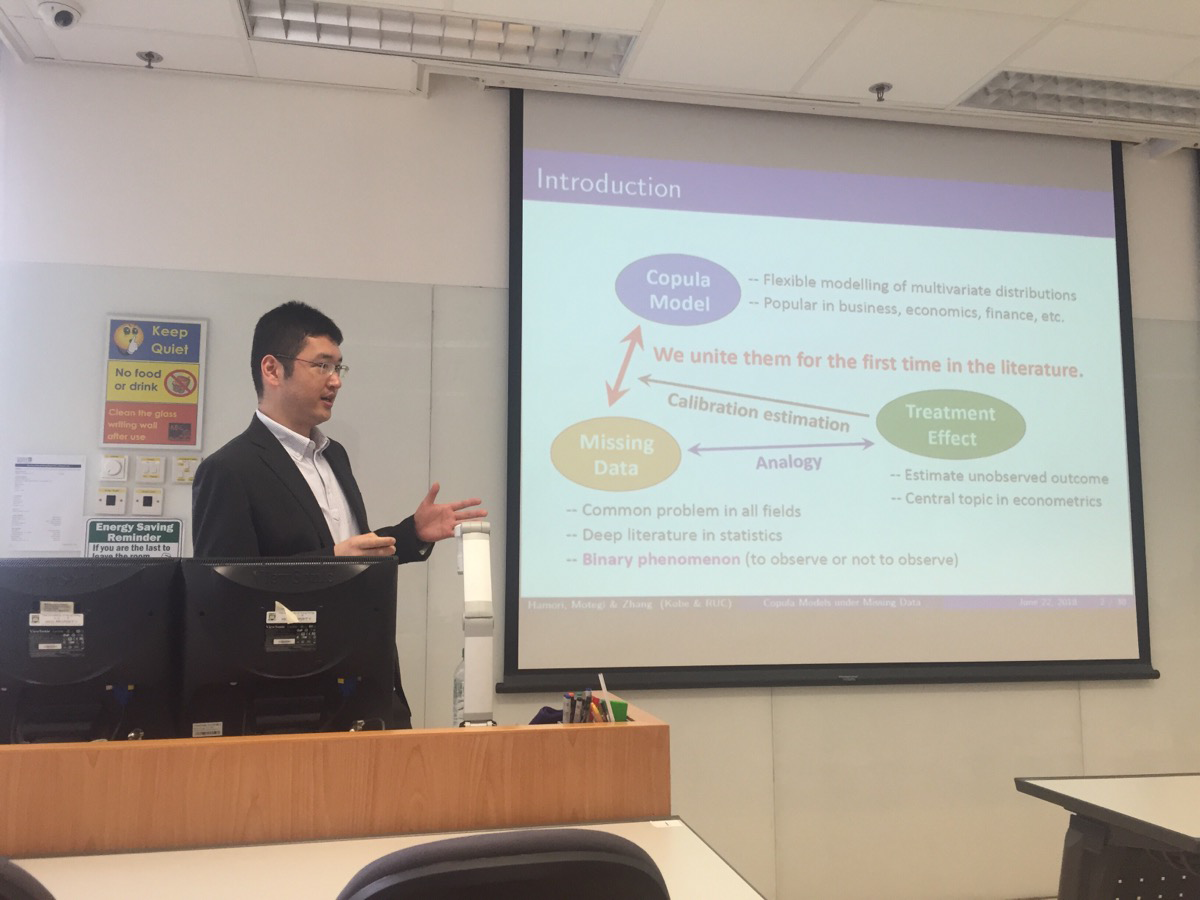
I gave a seminar talk at the University of Hong Kong in June 2018.
-
Asymptotic properties of spurious regression and random walks with generalized drifts (with J. W. Dennis). Main paper Supplemental material Matlab codes
Abstract: This paper investigates the spurious regression where each of the regressand y and the regressor x follows a random walk with generalized drift. The drift specification includes a zero, nonzero local, and nonzero constant drift as special cases. This framework is a substantial extension of the existing literature, in which both y and x have zero or constant drifts. We derive the order of convergence or divergence of the estimated slope coefficient and the squared t-statistic, as well as their asymptotic distributions. We find that the estimated slope may converge, diverge, or neither depending on the drift specification. Further, the asymptotic distribution of the scaled estimator of the slope takes on various interesting shapes such as a bimodal and asymmetric distribution. We also reveal that the squared t-statistic diverges at different rates across cases.
-
Conditional Threshold Autoregression (CoTAR) (with J. W. Dennis and S. Hamori). Main paper Supplemental material Matlab codes
Abstract: We propose a new time series model called Conditional Threshold Autoregression (CoTAR), in which the threshold is specified as an empirical quantile of recent observations of a threshold variable. The conditional threshold is expected to trace economic and financial variables well, as a cut-off level of low and high regimes likely changes over time. The presence versus absence of conditional threshold effects can be tested via the wild bootstrap, and the out-of-sample predictive ability of CoTAR can be evaluated via the Diebold-Mariano test. We show that CoTAR satisfies desired statistical properties in both large and small samples. We apply the proposed model to the CBOE Volatility Indices of S&P 500 and major U.S. shares, obtaining desired in-sample and out-of-sample results.
Regular and reverse Midastar models: Threshold autoregression with mixed frequency data (with J. W. Dennis and S. Y. Hong). Main paper Supplemental material Matlab codes
Abstract: We propose Midastar, a novel extension of the threshold autoregression (TAR) to the Mixed Data Sampling (MIDAS) framework. In the regular Midastar, the target variable is observed less frequently than the threshold variable. In the reverse Midastar, the target variable is observed more frequently. These models accurately capture threshold effects, whereas standard TAR with temporally aggregated data can point to spurious non-threshold effects. The parameters are estimated via profiling, and the no-threshold-effect hypothesis is tested via wild bootstrap. We establish the uniform consistency and asymptotic normality under much weaker conditions than in the literature. In particular, we overcome the challenges arising from the potential lack of stationarity. Monte Carlo simulations and empirical applications demonstrate that the Midastar models are useful for modelling and predicting macroeconomic and financial indicators.
-
An over-rejection puzzle of bootstrap average tests for the no-threshold-effect hypothesis (with J. W. Dennis). Main paper Supplemental material Matlab codes
Abstract: When testing the null hypothesis of no threshold effects based on threshold autoregressive models, wild-bootstrap supremum, average, and exponential tests are routinely used to handle an identification issue under the null. In this note, we demonstrate via Monte Carlo simulations that the bootstrap average tests lose control for the type-I error rate when the threshold variable is persistent and the delay parameter is chosen from more than a handful of choices. In some cases, the average tests reject the correct null hypothesis with probability exceeding nominal size by more than 10%. The size distortion is present even in large samples, indicating the average tests may not converge to the intended asymptotic null distribution. Supremum and exponential tests achieve correct type-I error rates, posing a puzzle why only the average tests suffer from over-rejections.
Other Papers
-
Mixed frequency vector autoregressive (MF-VAR) models and Granger causality tests. Journal of the Japan Statistical Society, vol. 50, September 2020, pp. 191-204, an invited special article as the 33rd JSS Ogawa Award Winner (written in Japanese). Main paper Matlab codes
Conferences and Seminars (Selected)
- 2013 North American Summer Meeting of the Econometric Society, University of Southern California, Los Angeles, CA, June 2013.
- 2013 NBER-NSF Time Series Conference, Federal Reserve Board, Washington DC, September 2013.
- 2014 Japanese Joint Statistical Meeting, University of Tokyo, Tokyo, Japan, September 2014 (selected as JJSM Competition Session Best Presentation Award Winner 2014).
- 2014 NBER-NSF Time Series Conference, Federal Reserve Bank of St. Louis, MO, September 2014.
- 25th (EC)2 Conference: Advances in Forecasting, Universitat Pompeu Fabra, Barcelona, Spain, December 2014.
- 11th International Symposium on Econometric Theory and Applications (SETA 2015), Hitotsubashi University, Tokyo, Japan, May 2015.
- 11th World Congress of the Econometric Society, le Palais des Congrès de Montréal, August 2015.
- 2015 Japanese Joint Statistical Meeting, Okayama University, Okayama, Japan, September 2015 (selected as JJSM Competition Session Presentation Award Winner 2015).
- Recent Developments in Time Series and Related Fields, Tohoku University, Miyagi, Japan, December 2015.
- 10th Spring Meeting of the Japan Statistical Society, Tohoku University, Miyagi, Japan, March 2016 (received Best Poster Presentation Award).
- 2016 Asian Meeting of the Econometric Society, Doshisha University, Kyoto, Japan, August 2016.
- 2016 NBER-NSF Time Series Conference, Columbia University, New York, September 2016.
- UNC Econometrics Seminar, Department of Economics, University of North Carolina at Chapel Hill, NC, February 2017.
- 11th Spring Meeting of the Japan Statistical Society, National Graduate Institute for Policy Studies, Tokyo, Japan, March 2017 (received Best Poster Presentation Award).
- 50th Anniversary Seminar, Department of Statistics and Actuarial Science, University of Hong Kong, Hong Kong, June 2017.
- 1st International Conference on Econometrics and Statistics (EcoSta 2017), Hong Kong University of Science and Technology, Hong Kong, June 2017 (session organizer and speaker).
- 4th Annual Conference of the International Association for Applied Econometrics (IAAE), Sapporo, Hokkaido, Japan, June 2017.
- 3rd Annual International Conference on Applied Econometrics in Hawaii, Honolulu, Hawaii, September 2017.
- Economics and Economic Growth Centre Seminar Series, School of Social Sciences, Nanyang Technological University, Singapore, January 2018.
- 2nd International Conference on Econometrics and Statistics (EcoSta 2018), City University of Hong Kong, Hong Kong, June 2018 (session organizer and speaker).
- Departmental Seminar, Department of Statistics and Actuarial Science, University of Hong Kong, Hong Kong, June 2018.
- Departmental Seminar, Institute of Statistics and Big Data, Renmin University of China, Beijing, China, August 2018.
- UNC Econometrics Seminar, Department of Economics, University of North Carolina at Chapel Hill, NC, November 2018.
- Presidential session, 88th Annual Meeting of Southern Economic Association, Washington DC, November 2018.
- Essex Centre for Macro and Financial Econometrics Seminar Series, Department of Economics and Business School, University of Essex, Colchester, UK, January 2019.
- 15th International Conference, Western Economic Association International (WEAI), Keio University, Tokyo, Japan, March 2019.
- 15th International Symposium on Econometric Theory and Applications (SETA 2019), Osaka University, Osaka, Japan, June 2019.
- Memorial Lecture for the 33rd JSS Ogawa Award, 2019 Japanese Joint Statistical Meeting, Shiga University, Shiga, Japan, September 2019.
- Departmental seminar, Department of Economics, University of Essex, Colchester, UK, September 2019.
- The Third Hosoya Prize Lecture, Graduate School of Economics and Management, Tohoku University, Miyagi, Japan, November 2021.
- 6th Annual International Conference on Applied Econometrics in Hawaii, virtual session, November 2021 (organizer and speaker).
- 5th International Conference on Econometrics and Statistics (EcoSta 2022), virtual session, June 2022 (session organizer and speaker).
- 16th International Symposium on Econometric Theory and Applications (SETA 2022), virtual session, July 2022.
- 2022 Asian Meeting of the Econometric Society in East and South-East Asia, virtual session, August 2022.
- 7th Annual International Conference on Applied Economics in Hawaii, virtual session, November 2022 (organizer and speaker).
- 17th International Conference, Western Economic Association International (WEAI), virtual session, April 2023.
- 98th Annual Conference, Western Economic Association International (WEAI), virtual session, July 2023.
- 6th International Conference on Econometrics and Statistics (EcoSta 2023), Waseda University, Tokyo, Japan, August 2023 (scientific program committee member, session organizer, and speaker).
- International Conference on Time Series Econometrics (ICTSE), Kobe University, Hyogo, Japan, March 2024 (organizer, chair, and speaker).
- 99th Annual Conference, Western Economic Association International (WEAI), virtual session, June 2024.
- NTU Economics Seminar, School of Social Sciences, Nanyang Technological University, Singapore, July 2024.
- Singapore Economic Review Conference, voco Orchard Singapore, July–August 2024.
- 9th Annual International Conference on Applied Economics in Hawaii, Honolulu, Hawaii, September 2024.
- 92nd Marunouchi Quantitative Finance Seminar, Tokyo, Japan, November 2024.
- 100th Annual Conference, Western Economic Association International (WEAI), virtual session, June 2025.
- Internal Seminar, Institute for Monetary and Economic Studies, Bank of Japan, July 2025.
- 8th International Conference on Econometrics and Statistics (EcoSta 2025), Waseda University, Tokyo, Japan, August 2025.
- Workshop "Research on the Frontier of Modern Economics", Institute of Economic Research, College of Economics, Aoyama Gakuin University, October 2025.
- 20th International Symposium on Econometric Theory and Applications (SETA 2026), University of Tokyo, Tokyo, Japan, June 2026.
- 101st Annual Conference, Western Economic Association International (WEAI), virtual session, June 2026.
- 9th International Conference on Econometrics and Statistics (EcoSta 2026), Ryukoku University, Kyoto, Japan, August 2026 (scientific program committee member, session organizer, and speaker).
Research Grants
- Suntory Foundation Grant for Young Researchers, Suntory Foundation, April 2016–March 2017.
- JSPS KAKENHI, Grant-in-Aid for Young Scientists (B), Grant Number 16K17104, April 2016–March 2019.
- Grants for Social Science, Nomura Foundation, April 2017–March 2019.
- Research Grant, Kikawada Foundation, April 2017–March 2019.
- Grant for Research, Mitsubishi UFJ Trust Scholarship Foundation, April 2017–March 2018.
- Research Grant, Japan Center for Economic Research (JCER), April 2018–March 2020.
- Research Grant, Nihon Hoseigakkai Foundation, April 2018–March 2019.
- JSPS KAKENHI, Grant-in-Aid for Early-Career Scientists, Grant Number 19K13670, April 2019–March 2022.
- Grant-in-Aid for Research, Zengin Foundation for Studies on Economics and Finance, April 2020–March 2022.
- Research Grant, Ishii Memorial Securities Research Promotion Foundation, August 2020–March 2022.
- Grants for Social Science, Nomura Foundation, October 2022–September 2024.
- Research Grant, Japan Securities Scholarship Foundation, October 2022–September 2023.
- Research Grant, Murata Science Foundation, August 2023–July 2024.
- JSPS KAKENHI, Grant-in-Aid for Challenging Research (Exploratory), Grant Number 23K17555, June 2023–March 2026.
- Research Grant, Trust Forum Foundation, April 2025–March 2027.
- Research Grant, Nihon Hoseigakkai Foundation, April 2025–March 2026.
- JSPS KAKENHI, Grant-in-Aid for Scientific Research (B), Grant Number 26K00326, April 2026–March 2030.
Editorial Services
- Associate Editor, Singapore Economic Review, January 2018–present.
- Associate Editor, Econometrics and Statistics (Part A: Econometrics), January 2026–present.
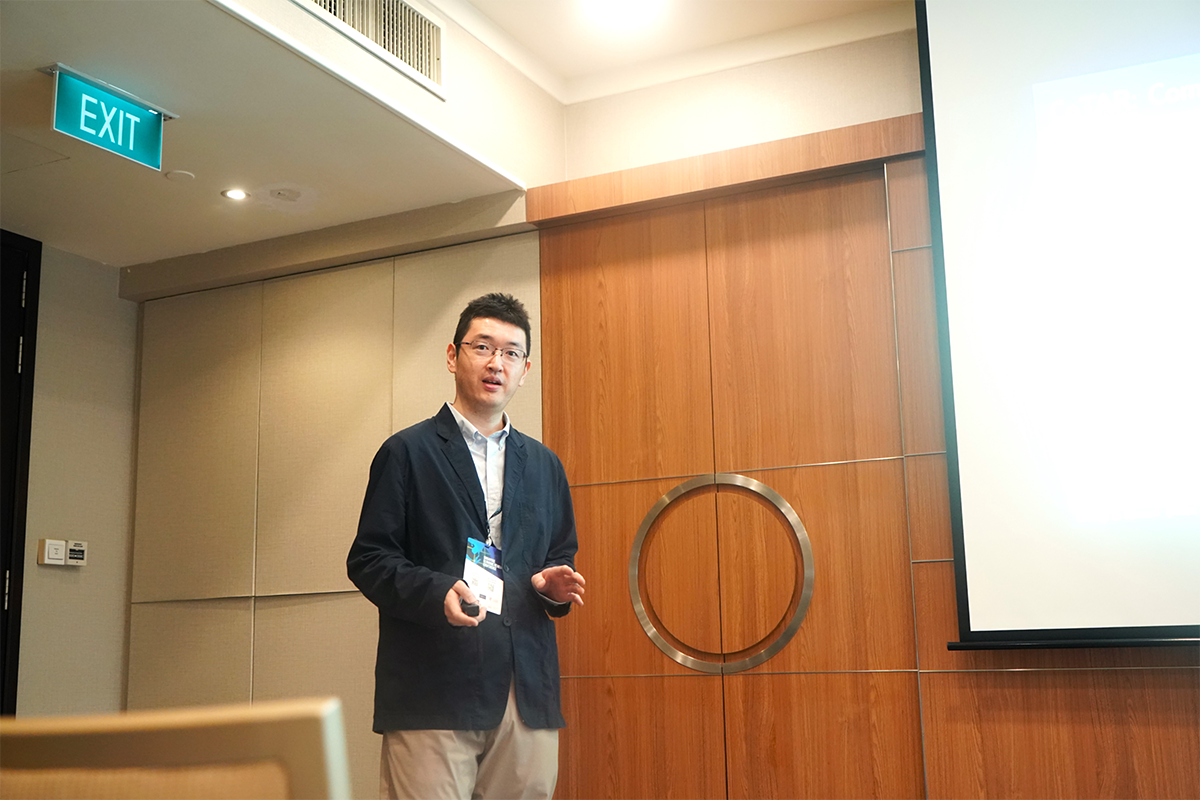
I gave a talk at the Singapore Economic Review Conference, voco Orchard Singapore in July 2024.