- International Field Work 2006: Observing the International Environmental Treaty Negotiations
- Conference: The Third Conference of the Parties to the Rotterdam Convention on the Prior Informed Consent Procedure for certain Hazardous Chemicals and Pesticides in International Trade
- Venue: Geneva International Conference Center (CICG), Geneva, Switzerland
- Period: October 9 ? 13, 2006
- Supervising Professor: Professor Akiho SHIBATA
The following report is submitted by Magyar Zsuzsanna Blanka, a member of the KURIM (Kobe University Research Institute for MEAs). Necessary amendments have been provided by the supervising professor.
SUMMARY
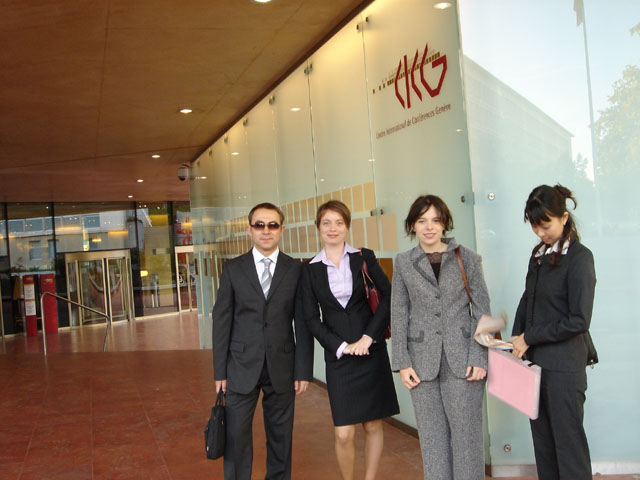
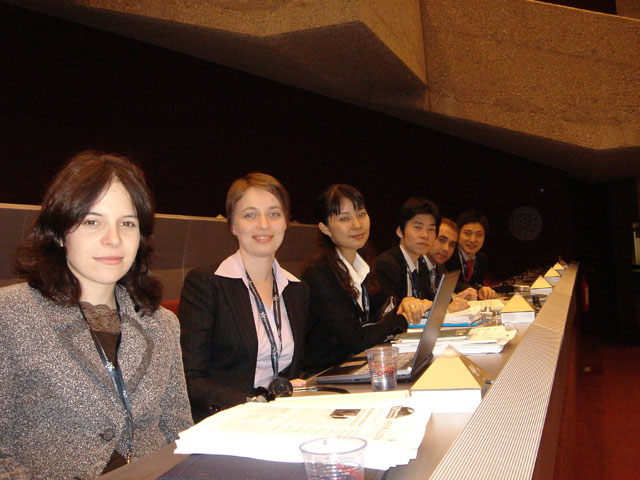
The Third Conference of the Parties took place from 9-13 October 2006 in Geneva. The participants arrived in Geneva on the 8 October and started to work in the morning of the 9th just as all the delegations do. All the members received an identification badge similar to the delegates of the countries only in a different color and had to go through security check each time entering the conference as all participants. The conference started with a plenary session, and, in this plenary, it was decided to establish, again, the open-ended Working Group on non- compliance procedure. From this point our members had to divide at least into two, as the plenary and the WG meetings were held concurrently. We decided to allocate at least one person in the plenary session to follow the general issues. In the mean time other members followed the non-compliance negotiations.
From the previous negotiations, we could predict the most important and sensitive issues in the debate. We could also predict the positions on these issues of some of the major countries and the negotiation-divides. Based on this prediction, KURIM decided to entrust two members with the observation of the two negotiating camps: one led by Japan and the other by the European Union.
After the first round of negotiation in the non-compliance working group three other countries were chosen because the students estimated that their positions might become interesting or important. These were: one African country: Ethiopia, one Asian country: India, and one Latin American Country: Chile.
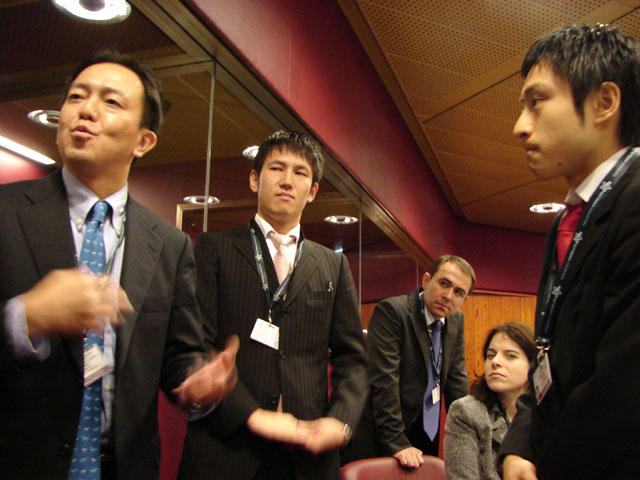
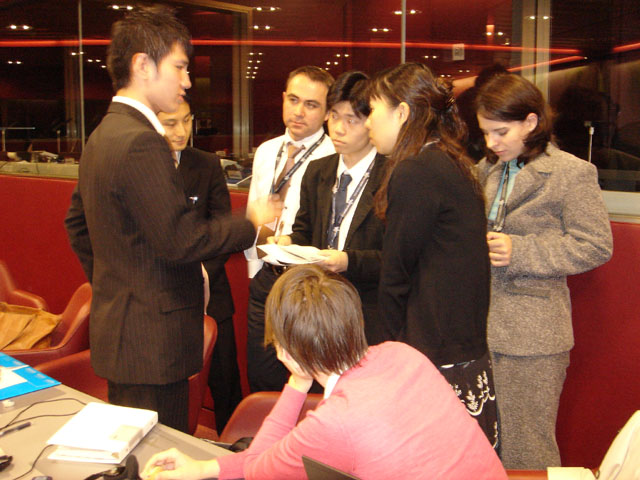
The assigned student had to follow the country’s movements and had to find out the possible reasons for each move. To achieve this, students had to listen carefully the official statements of those delegations and to follow “unofficial” or “secret” moves. We dared even to conduct personal interviews with the delegates, who were kind enough to explain some of the background events. KURIM followed the flow of the main negotiation, documented the events with pictures, cameras and written notes, followed the opinion leader countries, and the events of some of the numerous drafting and contact groups.
At the high-level segment of the plenary session, Yuichi Nakayama delivered a speech on the observations made by the KURIM in front of the delegates including several ministers.
NEGOTIATION ON NON-COMPLIANCE PROCEDURE
First Day (October 9)
On day one in the plenary session a Non-Compliance Open-Ended Working Group was established. The due date to report to the plenary was set on Thursday, October 12, morning.
The negotiation on the non-compliance procedure was based on the document UNEP/FAO/RC/COP.3/12. This was the draft prepared at the previous round of the negotiations at COP2. There were several brackets in the text indicating disagreement. The goal of this meeting was to come to consensus on the contentious issues, eliminating the brackets, so that the non-compliance mechanism could start operating.
The chair Denis Langlois from Canada offered five important points for the consideration of the group. If these five issues were resolved, he said, the meeting can almost automatically clear the text. These were: (1) general issues including membership in the non- compliance committee (Para 2, 2alt); (2) openness of the procedure towards the public and other parties (Para 8); (3) decision-making procedure by consensus or majority (Para 10/11); (4) the triggers of the procedure (Para 12 b, c 14bis.); and (5) additional measures that the committee may take towards non-compliant parties (Para 19).
In their initial statements each delegation expressed their opinions on these questions and two basic groups could be seen. One of them was led by the EU, supported by Norway, Switzerland, Ethiopia, South Africa, Nigeria, Jamaica and Mali (and other African countries). This Group advocated a transparent, effective, and strong system, with various measures, open committee sessions, 2/3rd majority in voting and both party-to-party and secretariat trigger apart from the self trigger.
The other group which advocated the opposite in almost every issue wanted a facilitative and supportive mechanism with consensus decision, closed sessions and facilitative not punitive measures, and only self trigger. The countries in this camp were Japan, Australia, India, Brazil, China, and the United States. The United States participated as a non-party observer. The only point where this clear-cut divide was broken was the issue of the membership of the committee. African and Asian countries were advocating a more equitable distribution, meaning more members from African and Asia compared to Latin America or Eastern European regions, with possibility of a bigger committee. However this was opposed strongly by EU and the Latin American Countries, which wanted small committee with equal distribution among UN five regional groups. There was only one delegation that advocated the PIC seven regions - Australia.
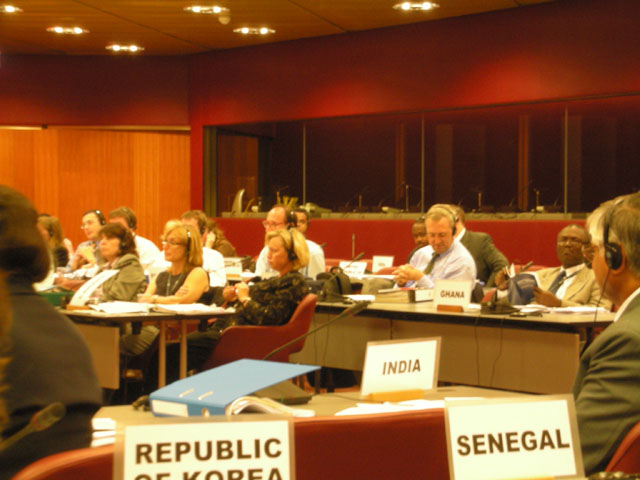 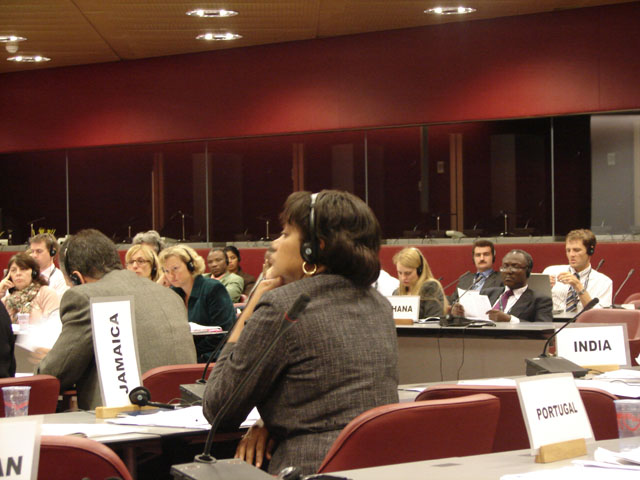
The African and European delegations seemed to be well organized and on consensus, while in the Asian group and the Latin American group there were some differences. Other countries such as Malaysia, Oman, Equator, Mexico, Venezuela, Ghana, Thailand, and Argentina also took part in the discussion somewhat in between the two extreme opinions. The large number of participants in the discussion indicated that the conclusion of the negotiation was essential for many countries.
The Latin American countries (or GRULAC) seemed to be much closer to the group which was led by Japan, but they had no clear consensus. They had rather varied opinions and it seemed that they did not coordinate among themselves before the meeting.
KURIM was watching closely the movements of the EU and Japan because they seemed to have distinct and clear positions and we expected that they might take leadership in voicing that opinions and coordinating the other delegations. We chose India to have a developing country from the Japanese group. Ethiopia seemed to be the leader in representing the African interests and was a developing country. We chose Chile to follow the position of the GRULAC and to see whether a regional consensus would emerge or whether these countries will negotiate on their own.
My task was to observe Chile in the negotiations, later two other Latin American Countries Brazil and Argentina that seemed to have a rather articulated position on the questions.
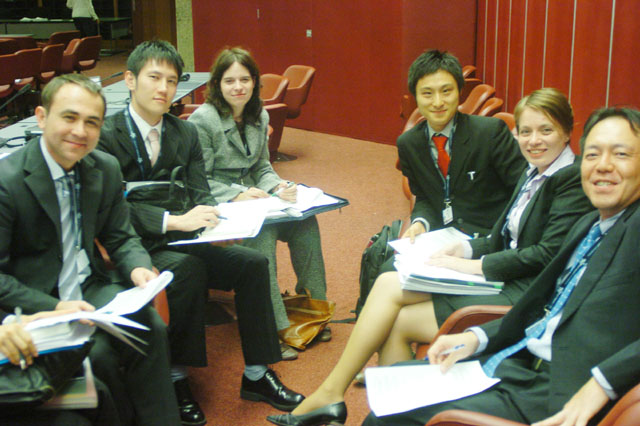
(Photo by IICD)
Second Day (October 10)
After the initial statements, on day two, the real negotiation on each of the five issues began. The chair suggested to debate on the question of decision-making process first. He recommended that 2/3 majority voting would be allowed in case consensus cannot be reached.
From the GRULAC only a few countries intervened on this subject. Brazil and Argentina seemed to be rather supportive of the consensus, while Chile supported majority voting. The delegations expressed their distinguished positions that they have expressed on the first day. The chair recalled that the Basel Convention Compliance Mechanism has also majority voting and the COP has to make decisions based on consensus. But the majority of the opposing delegations reiterated their positions, so the debate came to a deadlock.
The second question the meeting addressed was the issue of additional measures (Para. 19). Japan noted that before discussing on the decision-making process the more essential issues like the issue of additional measures should be addressed. The chair suggested that there was a certain agreement on the measures urging compliance but this was not the case with more punitive ones, so he suggested discussing these issues.
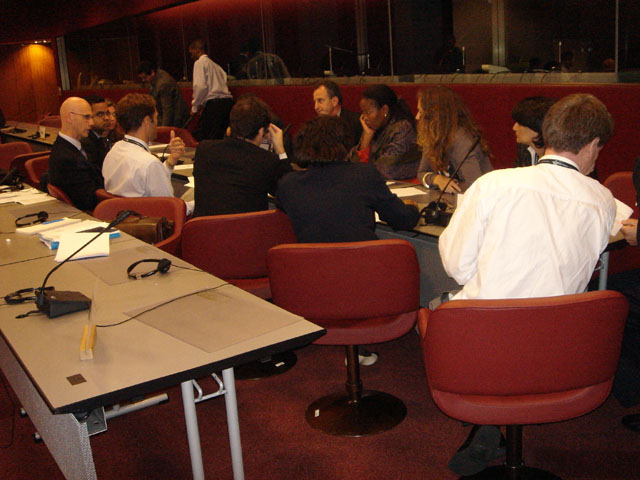
The group was similarly as divided as before along the line of the previous day. On this question, the Latin American countries pronounced similar views supporting the facilitative approach without punitive measures. The chair suggested that the second half of the most controversial measure in subparagraph (g) should be deleted as a compromise. This suggestion was acceptable to EU and its allies, but the opposing group still wanted to see the whole subparagraph (g) to be deleted. Noticing that the other side is not ready to compromise, the EU and the African countries backed off from this compromise solution and reiterated their original position. As the negotiations seemed to be halted again, the Chair put two separate brackets in this subparagraph indicating that the half of the sentence may be deleted.
On the other additional measures, that is determination of non-compliance and provision of cautionary statement, the Chair suggested wording based on the Basel Convention. Japan suggested an entirely different version. The Chair asked them to form a drafting committee in the lunch break and try to come up with a solution acceptable to all delegations.
In the afternoon session debates continued on the additional measures. The Japanese draft was tabled that deleted the possibility of the suspension of rights and privileges. But this was not acceptable to the EU. There was a debate whether the list of measures should be open or closed.
According to my personal interview with the Chilean delegation, GRULAC did not have common position. She explained frankly that Brazil ,Venezuela and Ecuador had one position but Argentina and Chile had another. But she also said that, after coordination among the members in the morning regional group meeting, a consensus position among the GRULAC countries could be expected from the third day. She explained that the biggest dividing issue among the Latin American countries was the question of getting the decisions by consensus or by vote. When I asked about the two opposing groups the Chilean delegate expressed the view that Japan was more flexible than the EU. From this I assumed that they might be closer to the viewpoint of the former. On several times, Brazil and other member states of the GRULAC already supported the position of Japan. I predicted that the Latin American countries would come to consensus along the line of the Japanese camp.
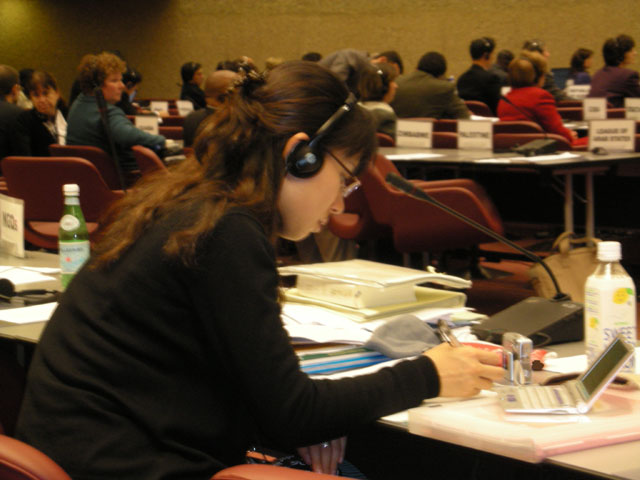
Third Day (October 11)
The most important issue for the participants of the negotiations was whether the committee should be able to suspend rights and privileges of a non-compliant Party. EU argued that as a compromise the non-compliant Party should at least not be able to hold the position of COP president or to become a member of the Bureau. Many delegations opposed that it is difficult to do this practically. As for the openness or closeness of the list, the EU argued that they could only accept the closed list if some measures they wanted are included in the list. This meant that EU wanted to bargain. They expected that other countries would be somewhat more willing to accept stronger measures in exchange. However at this point there was no compromise. The Chair set up a contact group co-chaired by Norway and Tanzania to work on the alternatives on Paragraph 8
The next item to be discussed was the issue of triggers. The delegations also announced their positions in blocks, first those who opposed both secretariat and party-to -party trigger (Japan, India, Australia, and China), followed by EU and its allies who thought that with only self-trigger the mechanism would not be effective. There were some delegations like Brazil who accepted party-to-party trigger in case the Parties are directly involved with each other. Canada tried to give a compromise suggestion to limit the secretariat trigger and the party-to- party trigger but this was not accepted.
The Chair is from Canada. This meant two things: its original positions were not extreme; and, consequently, it was in a position to help the Chair by providing compromise suggestions on many occasions. No Latin American delegation spoke on this issue indicating that the question of triggers is irrelevant for them. The chair set up another contact group on the issue with Switzerland and Jamaica as co-chairs.
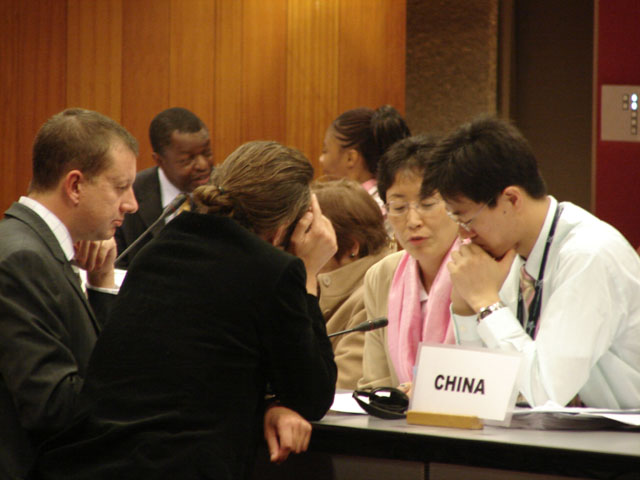
The last question was the composition of the committee. This question had to be solved as the secretariat was preparing the draft budget for the next two years and they needed the exact number of committee members to calculate the travel assistance costs. At this point we could see another type of negotiation situation. The group was bound to a time limit and they had to create a consensus. A few delegations argued to create a big compliance committee notably India which protected very much the interest of the Asian and African groups by advocating equitable distribution and not equal numbers among the regions. EU and other delegations in order to be efficient supported a ten-member committee. The delegate of Japan had a suggestion of asking the members of other MEA’s compliance committees. There were several persons in the room who served as compliance committee members of Montreal Protocol, Basel Convention, ECE Long-range Transboundary Pollution Convention. Professor Shibata was one of them. They advised that the number should not be less than 10 and should not be more than 15. This helped the delegates to come to a consensus that there will be 15 members of the committee. Australia still argued for PIC regions which would have needed a multiply of 7. But due to the pressure the Australian delegate agreed to the number 15 and promised to seek approval from the capital for UN regions-based composition. It seemed that the delegate from Australia had very strong directions and small mandate for negotiation.
As there was only pressure to decide on the number of the members in the committee and not the actual distribution among the regions, no consensus was reached on this point. This was more important for the countries because none of them wanted to loose positions. As mentioned before, African and Asian countries wanted to have proportionally more members than the other regions. This positions was squarely opposed especially by EU and Latin American countries. The Chair set up a contact group on this question as well
The contact group on triggers led by Switzerland could not come up with a consensus. The group produced a cleaner text however than what was before with clearer choices. On the additional measures, especially paragraph 19 (g), China offered a new language “address” which the EU was reluctant to accept.
There was no advance on the question of the decision-making. The negotiation moved to the question of openness or closeness of the committee. The basic question was here eventually whether the process should be initially open and be closed if the party whose compliance in question so requests or the opposite. The parties who preferred closed sessions even argued that not only public but other parties as well should be barred from the process. From GRULAC, only Venezuela and Argentina raised their voice, and they supported a closed process.
A budget issue was raised for the second time when the decision about the schedules of the meetings came up. Japan expressed its concerns about the necessity of meetings between the sessions. However there was a consensus that there should be some scheduled meetings in case non-compliance occurs. However the group took into account Japan’s concerns when reporting to the COP.
The delegate of Chile explained that finally there was no formal common position formed among the GRULAC members. She said that other matters were more important to the Latin American countries such as the synergies. Chile was still on the opinion that it could make compromises with the EU on the matter whether the procedure should be open or closed to the public, while Brazil and Argentina was very much devoted to the facilitative system point of view.
Fourth Day (October 12)
By Thursday morning no consensus was reached and the chair asked for extension. As Australia expressed its view that the negotiations do not have to be necessarily successful at this round there was some risk that the country - or any other country would veto the permission. However the extension was granted. As everybody made their position clear in the first three days compromises were expected.
All the delegates were asked the day before to contact their capitals during the night and ask for flexibility in the mandate. The capital of Australia did not allow any more compromises apart from the giving up the PIC regions. They made the somewhat unorthodox suggestion to leave the brackets in the text and start the committee on the agreed version. They had not much to risk as the text with brackets were the points they did not want. Japan and India supported the idea while the other countries led by EU strongly opposed it. With this solution they would have lost all their demands for an indefinite time.
The Chair at this point invited the most important members of the debate for bilateral talks, to find out what are the bottom lines and how far their mandate could be stretched. By the end of the day he presented to the Working Group with the draft proposals of the Chair and asked the members to conduct discussions with their respective capitals overnight if necessary. This targeted especially Australia and China who seemed to have little mandate and could not consult with their capitals during daytime because of the time differences with Geneva. The session ended as the translation ended as China was not willing to conduct any further negotiations only in English.
The Chair created a friends of the chair circle. He included Switzerland, China, Japan, India and Australia. Brazil and Ethiopia asked for representation of GRULAC and Africa and were accepted. Upon these discussions the chair offered a draft version of the possible compromise text.
The delegate of Chile was very cautious to give any comments at this point. The tension was really high. Argentina was negotiating vigorously with all the African countries supposedly on the issue of the membership. As the Japanese delegate later explained GRULAC was not supporting the idea of leaving the text half finished in this important issue they agreed with the EU and wanted to finish the negotiations.
Final Day (October 13)
The next day the Chair’s draft was available in all UN languages. The translators translated it overnight in Nairobi. The Chair organized two contact groups on two outstanding issues. One was on the role of the secretariat in triggering. This group became a closed session as it was one of the most controversial issue. The other one was the problem of the regional distribution in the Committee and the additional measures . The co-chairs became Brazil and Norway.
However as neither of these contact groups managed to reach compromise, the negotiations were closed. They will be continued in 2008 during COP 4 in Rome but it is difficult to assess what will be the opportunities of the developing countries to participate in the event, whether they will be able to finance of bringing experts to the conference.
CONCLUSION AND THINGS I LEARNED
It was really rewarding to follow the real negotiations and to compare with the mock negotiations we had in the GSICS last year. First it was interesting to see how the countries broke down into two groups, supporting two different types of compliance mechanism. We could assume that there are political reasons behind the two concepts one with the simplest possible mechanism with only self trigger and closed committee settings with only facilitative measures. I had the feeling that these are the countries that have some reasons to worry about their compliance.
However as the Japanese delegate explained later there can be other tactical reasons as well, for some countries this issue might not be that important but they can take interest in how generally international law is formed because they know that in other MEAs they will need this precedent.
This seemed to be a very valid argument as the precedents in other MEAs really had a big role during the negotiations. Often when the chair made suggestions he cited the Basel Compliance Mechanism and called for consensus in light of the fact that the respective governments had already once accepted these terms.
It was also interesting to see how time limit and pressure can effect the negotiations. Australia gave up its position about the PIC regions under the pressure to decide the number of the committee members. To avoid this pressure Australia was the one who was emphasizing throughout the negotiations that a conclusion is not needed at this round.
The debate between China and the EU about the word “remedy” or “address” in a sentence was also interesting. It showed how the delegations were trying to stretch their mandate to reach a compromise. China used another tactic with renouncing all attempts to negotiate only in English. The experts of the country had good command of English and participated in drafting committees and contact groups, which were conducted in English. However night sessions had to finish twice early because China did not accept the negotiations without interpreters.
China’s position in itself was interesting. Although Japan seemed to be the leader of the group of the more facilitative approach in the beginning, at the end, China and Australia seemed to be the strongest opponents of the EU. Maybe, they had the smallest mandates.
Australia was strong during the negotiations of the non-compliance mechanism of the Basel convention as well, but China put surprisingly big efforts in these negotiations. Either the country has strong interest in the issue or they showed a new approach to international MEAs and we can expect stronger views from this country in the future.
For me it was interesting how Latin American countries moved to consensus by the end and how leaders -Brazil and Argentina became apparent. For them clearly the most crucial point was the membership question. The non-compliance committee is not supposed to be political body, this fact was emphasized by almost all countries but in the mean time they wanted better positions in it which was an inconsistency. It seemed that they all know that it might become a political body.
The Chair had a lot of responsibility and sometimes he offered solutions which were unacceptable to the whole group. On the final day, Ethiopia even threatened with requesting a change of the Chair. As the Chair was elected by consensus this was a valid threat although at the afternoon of that last day, it seemed to be more a bluff than a real suggestion. However, with this suggestion Ethiopia made a strong point against the suggestion of the Chair which seemed to favor the suggestion which was supported by only one country, China. The biggest players, the EU, Australia, Japan ,Brazil were fast to support the Chair but in the final draft the text was back to the original so Ethiopia reached its aim.
It was interesting to see how the African countries emphasized their status of being developing countries and to be poor to have bigger attention. The EU was emphasizing on the other hand that it was talking in the name of 27 countries, which the Chair took into account. However I had the impression that the EU was lucky that Norway and Switzerland are not members as at least in this way they had always had 3 voices.
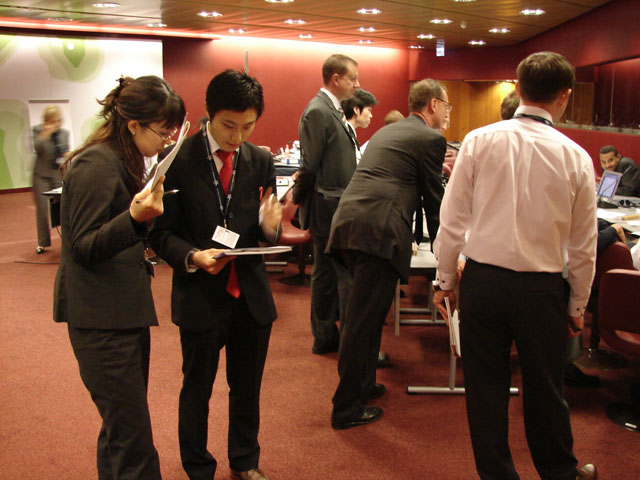 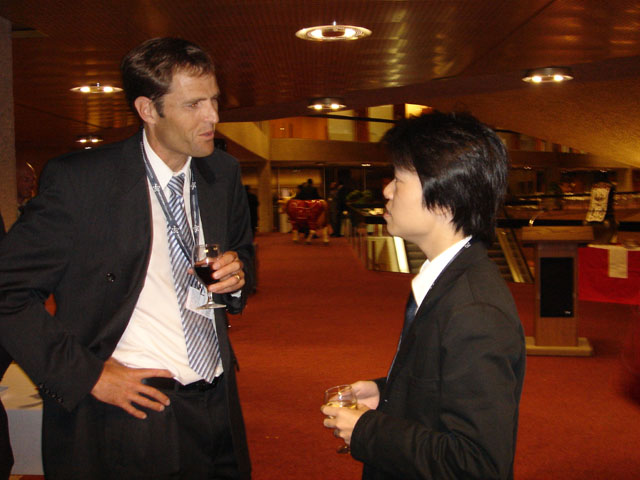
It was interesting to see how the negotiations on the corridors work, for instance before the last meeting the delegate from Argentina made constant efforts to try to convince the most important African countries, most probably about the distribution of the members in the Committee. He was talking with Jamaica, South Africa, Nigeria, with little luck apparently. Australia as mentioned had serious negotiations with some of the members before its strategic move, and the countries when they felt the need had private discussions during sessions as well.
It was a good lesson to learn that in real life negotiations there are times when countries simply do not compromise. This was not possible in the mock negotiations we had in the class last semester.

|












 Contact
Me
Contact
Me